
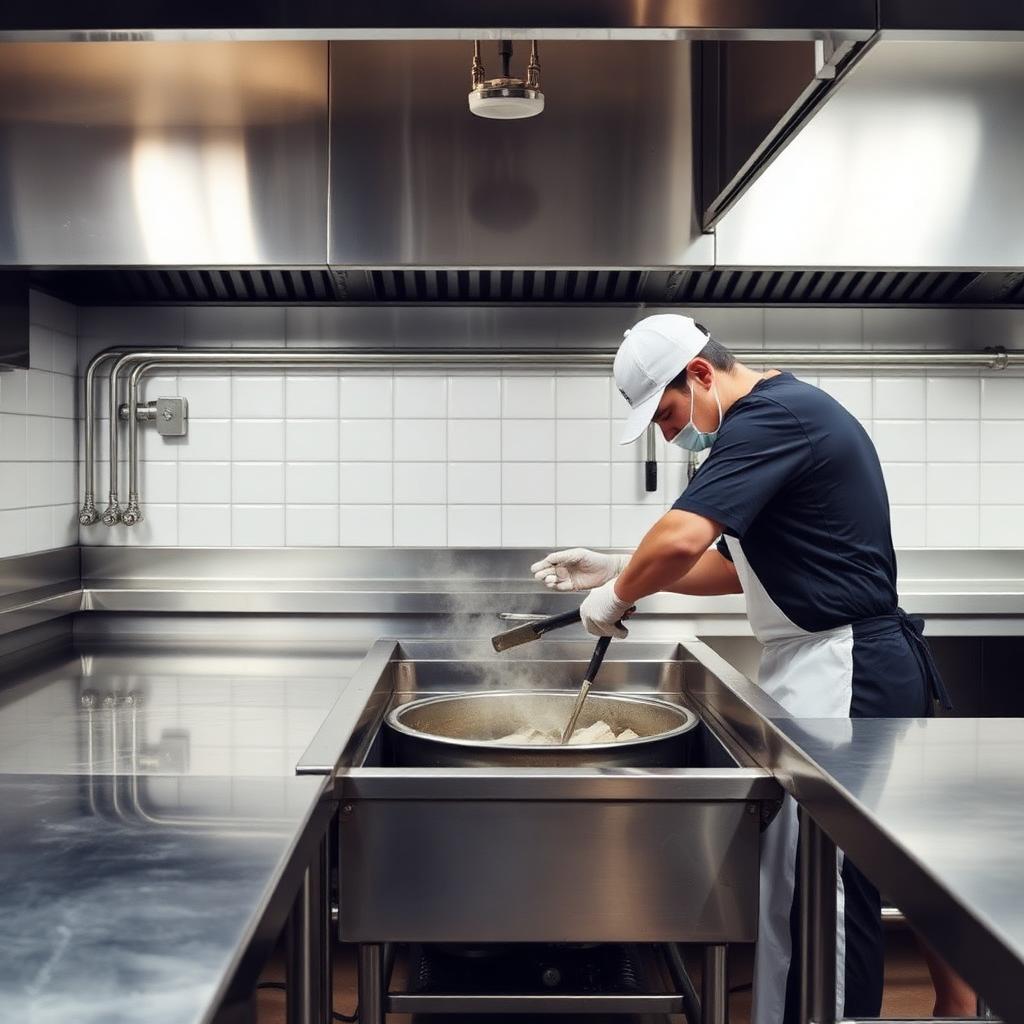
A restaurant owner calls at 4 p.m. on a Friday: the dining room smells like a sewer, the health inspector is coming Tuesday, and the grease trap was "pumped last month." All three things can be true simultaneously — and usually are.
Pumping a grease trap and cleaning a grease trap are two different jobs. Pumping removes the liquid and floating grease. Cleaning removes the caked film on the walls, the baffle buildup, and the solidified layer at the bottom that pumping leaves behind. Most "pumped monthly" traps have never actually been cleaned.
What a grease trap actually does A grease trap (or grease interceptor, for larger units) is a passive settling chamber. Wastewater from sinks and dishwashers enters, slows down, and separates: fats/oils/grease (FOG) float to the top, solids sink to the bottom, and relatively clean water in the middle exits to the sewer.
It works entirely on residence time and gravity. There are no moving parts and no active treatment — which is why a poorly maintained trap goes from "working" to "backing up into the kitchen" with almost no warning.
The 25% rule (and why most operators ignore it) The industry standard, echoed in most municipal FOG ordinances, is the **25% rule: pump the trap when combined FOG and solids reach 25% of the trap's total depth.** In a busy kitchen, a 50-gallon under-sink trap hits 25% in 2–4 weeks. A 1,500-gallon outdoor interceptor hits 25% in 60–90 days.
Operators who wait until the trap smells or backs up are usually at 60–80% capacity — at which point the trap has stopped separating entirely and raw FOG is flowing straight to the sewer main. That's the point where the health inspector shows up, or worse, the city bills you for a grease-related sewer blockage two blocks downstream.
Pumping vs cleaning vs treating Three different jobs, often confused:
- Pumping — a vacuum truck removes the liquid contents. Fast, required by law, and it's what "grease trap service" usually means on an invoice. Leaves behind the wall film, baffle buildup, and hardened bottom layer.
- Cleaning — after pumping, the trap is manually scraped, walls pressure-washed, baffles inspected, and the inlet/outlet tees cleared. This is what actually restores the trap's separation capacity.
- Biological treatment — between pumpings, live bacteria digest the residual FOG on the walls and in the downstream lines. This is what controls odor and keeps the drain lines flowing between service visits.
A properly maintained trap gets all three. A poorly maintained trap gets only pumping — and eventually needs jackhammer-level cleaning to recover.
Why grease traps smell (even when "clean") The smell isn't the grease. It's the anaerobic bacteria breaking down protein and fat in the absence of oxygen, producing hydrogen sulfide (rotten-egg smell), skatole, and volatile fatty acids. That fermentation happens in three places you can't see:
1. The film coating the inside walls above the water line. 2. The organic buildup on the outlet baffle. 3. The grease-choked drain line downstream of the trap.
Pumping removes the fuel in the middle of the tank but leaves the fermentation sites intact. Within 48 hours of a pump-out, a neglected trap smells the same as it did before service — because the walls and downstream line were never treated.
A 6-step maintenance protocol 1. **Log FOG depth monthly.** A simple dipstick reading (or a service tech's core sample) tells you when you're approaching 25%. This is the single most cost-effective control in the whole program. 2. **Pump at 25%, not "quarterly."** Calendar-based pumping either overpays (small kitchens) or underpays (high-volume operations). Depth-based scheduling matches cost to actual use. 3. **Full cleaning at every pump-out.** Confirm on the invoice: walls scraped, baffles inspected, inlet/outlet tees cleared. If the service call took under 20 minutes for a 1,000-gallon interceptor, only pumping happened. 4. **Biological drain treatment 3–5 nights per week.** Applied at the drain line, not into the trap. The bacteria travel through the trap and colonize the downstream line where hardened grease causes the sewer-side blockages. 5. **Kitchen-side controls.** Scrape plates before dish sinks, use strainers on every drain, and hold fryer oil back for licensed rendering pickup. Every gallon of FOG kept out of the trap is a gallon you don't pay to pump. 6. **Annual internal inspection.** Baffles corrode. Concrete traps develop cracks that let groundwater in and grease out. A once-a-year inspection catches structural issues before they become municipal fines.
When "clean" isn't enough A well-maintained trap still isn't a complete FOG program. Ejector pits, lift stations, and long horizontal drain runs downstream all accumulate grease that no amount of trap cleaning can reach. **The trap's job is to be the last line of defense — not the only one.** A layered program (source control, drain treatment, trap cleaning, downstream monitoring) is what keeps restaurants and multi-tenant buildings out of the municipal FOG compliance file.
The takeaway: if your only grease-trap line item is "quarterly pumping," you're paying to move the problem around, not solve it. Depth-based scheduling, full cleaning at every service, and nightly biological treatment is the combination that keeps traps working, drains flowing, and inspectors moving on to the next block.