
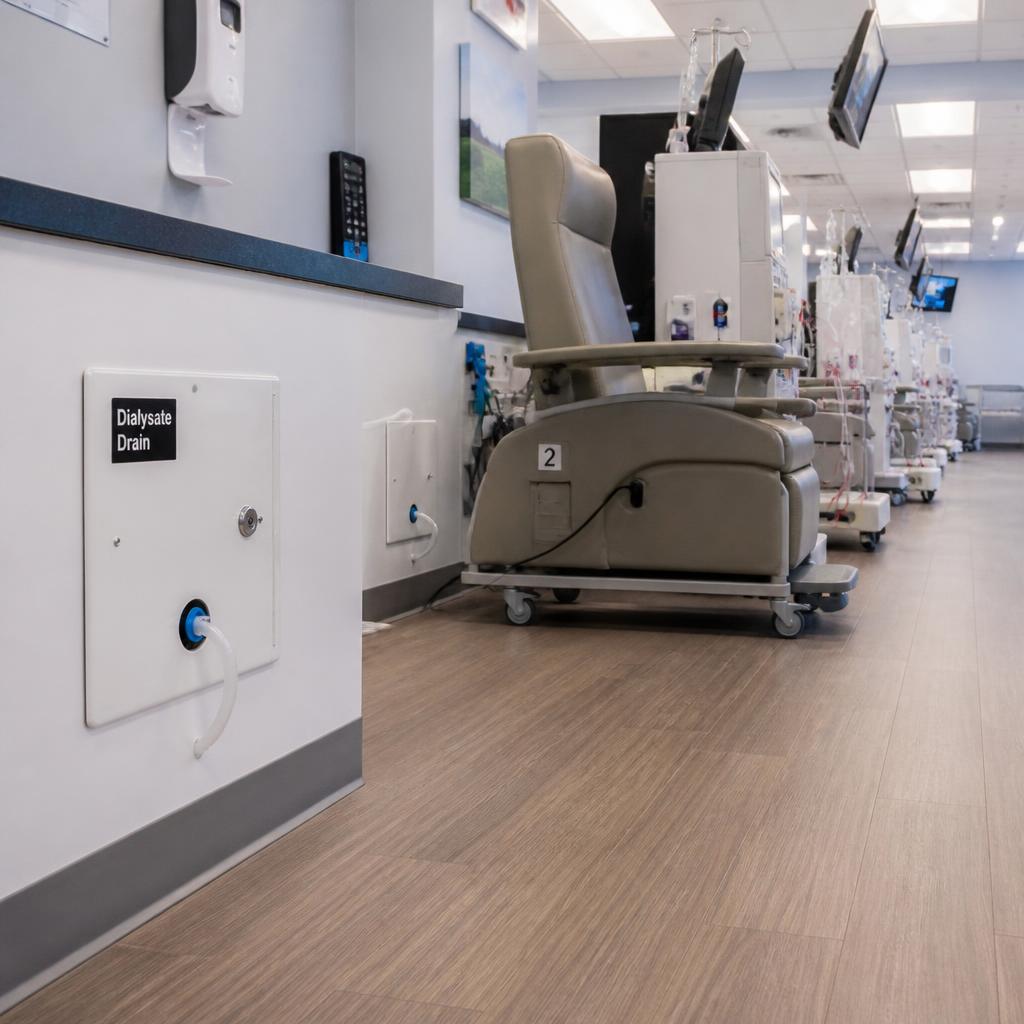
Ask a BioMed Technician or an Environmental Services director at a dialysis center what their most persistent, least-solvable facility problem is, and the answer is almost always the same: the drains. Wall box drains clog. Floor sinks smell. Small dark flies appear around the treatment bays. And no matter how many times a plumber snakes the line or a janitor mops the floor, everything is back within a few weeks.
This isn't a housekeeping failure. It's a chemistry problem specific to how hemodialysis works — and it can be solved permanently, but not with the tools most facilities are using.
In this guide we'll walk through why dialysis drains fail the way they do, what the CDC actually says about wall box drains and biofilm, why acid drain cleaners and pesticide sprays make the problem worse over time, and what a properly engineered automated drain-treatment program looks like inside an ESRD facility.
Why Dialysis Drains Are Different From Every Other Healthcare Drain Every hemodialysis station has a wall box — the recessed panel behind or beside the treatment chair that carries acid concentrate, bicarbonate concentrate, RO water, and the waste dialysate line. When a treatment ends, the used dialysate — spent buffer solution carrying the metabolic waste pulled out of the patient's blood — is discharged down that drain, or into a floor sink at the foot of the wall.
That waste stream carries two things no ordinary drain has to deal with at that concentration:
Bicarbonate concentrate deposits mineral scale. The bicarbonate buffer used in every treatment leaves calcium carbonate and mineral deposits on the inside of the drain line. Over months, that scale ring narrows the pipe. Water backs up. Slow drains become full clogs. This is the same chemistry that scales bicarbonate mixing tanks — the industry technical service bulletins have documented for years that these internal deposits require periodic descaling.
Organic metabolic waste feeds biofilm. Used dialysate is nutrient-rich by definition. It coats drain walls with a thick biological film — the same kind of biofilm that grows in sewer lines, but concentrated in a small clinical drain that gets loaded every 3 to 4 hours per station.
What the CDC Says About Wall Box Drains The CDC's guidance on dialysis water and wall box maintenance is explicit: *"Wall box drains contain drains that are predisposed to the development of biofilms… Biofilms in wall box drains may contain opportunistic pathogens that can cause healthcare-associated infections."* That's the regulatory context every ESRD facility is operating in — the drain isn't just a housekeeping issue, it's an infection-control surface that state surveyors are increasingly aware of.
The CDC recommendations include routine disinfection of the drain and the surrounding wall box interior, and documented maintenance procedures. What the CDC does not tell you is which chemistry actually works long-term without destroying the drain line — that's a facility engineering question, and it's where most centers get it wrong.
Why Drain Flies Show Up (and Why Spraying Them Never Works) The small dark flies that appear around dialysis floor sinks are almost always Psychodidae — drain flies, sometimes called moth flies. They don't come in from outside. They breed inside the drain, in the biofilm layer, and they can complete a full generation in as little as ten days.
Spraying the adult flies with an insecticide knocks down the visible population for a shift. It does absolutely nothing to the larval mat living in the biofilm one to six inches down the pipe. Within days, a new generation emerges and the problem is back — often worse, because the sprays kill nothing that matters and add chemical residue to a patient-care environment.
The only way to end a drain fly problem in a dialysis center is to remove the biofilm they're breeding in. Everything else is treating symptoms.
Why Acid Drain Cleaners Fail in ESRD Facilities The instinct when a wall box drain clogs is to reach for a strong acid or caustic drain opener. Two problems with that in a dialysis setting:
First, aggressive acid dumps damage drain piping over time — and dialysis facilities have specific plumbing requirements that don't tolerate that kind of chemistry cycle after cycle.
Second, acid cleaners destroy the biological ecosystem the drain needs. A stable, low-load biological population in the drain line actually helps keep it clear. Nuke it every three months with acid, and the biofilm regrows aggressively as soon as the acid clears — usually within a week.
The Used-Dialysate Odor Problem Patients spend three to four hours in the treatment chair. Even a faint urine-like odor drifting up from a floor sink is impossible to ignore from that position. Aerosol air fresheners are the wrong answer twice: dialysis patient populations include a high percentage of people with chemical sensitivities, and the added fragrance load reads as "covering something up" rather than fixing anything.
The right approach is a low-intensity, fragrance-free nebulized neutralizer sized for the treatment bay — chemistry that binds and eliminates the volatile compounds without adding a scent of its own. Restrooms and family waiting areas can carry a slightly more traditional program, but the treatment floor should read as clean, not scented.
What an Automated Drain-Treatment Program Actually Looks Like Here's what works in practice inside an ESRD facility:
Automated dosing hardware at every wall box and floor sink. Small programmable dispensers plumbed above each drain, delivering a measured dose on a schedule tied to your treatment shifts — typically overnight and between shifts, so nothing interferes with patient care.
A bio-enzymatic maintainer formulated for the load. Multi-strain bacterial formulations engineered to digest the organic biofilm dialysate leaves behind. The chemistry runs continuously at low concentration, so the drain never gets to the point where a fly population can establish or where a clog can form.
Periodic bicarbonate scale cycles. A non-acid descaling treatment run on a documented interval to strip the calcium carbonate ring bicarbonate concentrate leaves inside the line — no acid dumps, no piping damage.
Documented service records. Every dose, every service call, every descaling cycle logged and available for infection-control audits and state surveys. The paperwork is often as valuable as the chemistry itself.
What Changes Inside the Facility Centers that switch to an engineered drain program typically see the drain-fly population gone within one full treatment cycle, no wall-box clog calls to the plumber for the balance of the year, and a measurable drop in patient odor complaints logged in the QAPI records. Environmental Services stops chasing the same drains week after week. BioMed stops fielding "the drain is backing up in Bay 4" phone calls at shift change.
If you run BioMed or Environmental Services at a dialysis center in the tri-state area and any of this sounds familiar, our team specializes in this exact application — we'll walk your wall boxes, look at your floor sinks, and put together a program sized to your treatment schedule.