
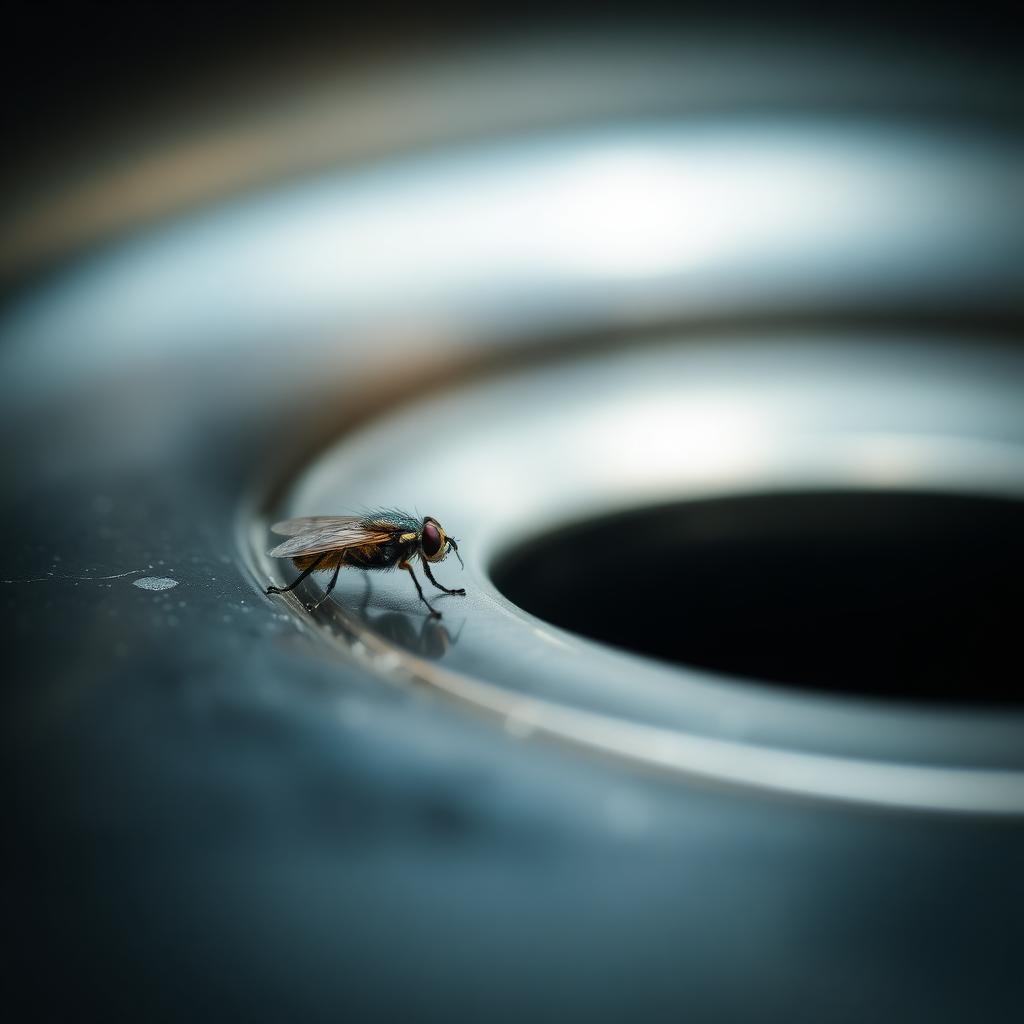
A restaurant manager walks in Monday morning and sees a cloud of tiny, fuzzy flies rising off the bar sink. She pours bleach down the drain, they disappear for a day, then come back thicker on Wednesday. By Friday they're in the dining room and a guest is filming them.
If that sounds familiar, the problem isn't the flies. It's what they're eating — and where.
Drain flies (also called moth flies) don't fly in from outside. They hatch inside your drains, feeding on the organic biofilm coating the pipe walls. Every bleach flush, every hot-water rinse, every enzyme "drain treatment" that fails to remove that biofilm is a signal to the next generation: keep laying eggs here.
Where drain flies actually come from Adults live 8–24 days. Females lay 30–200 eggs at a time on the film of grease, hair, soap scum, and food particles that lines the inside of every drain in a commercial building. Larvae hatch in 32–48 hours and feed on that film for up to three weeks before emerging as adults.
That's why a "clean-looking" floor drain still produces flies: the food source is the coating on the pipe, not what's visible on the strainer.
Why bleach and boiling water don't work Bleach is a surface disinfectant. It kills what it touches for a few seconds, then rinses away — it never dwells long enough to break down the biofilm holding the eggs. Boiling water has the same problem: it cools within a few feet of pipe and the film is untouched below.
Both methods knock down the visible adults for 24–48 hours, then the next brood hatches and the population rebounds larger than before. You're treating symptoms while the nursery keeps operating.
Chemical drain openers vs biological drain treatment Chemical drain openers (sulfuric acid, sodium hydroxide) attack organic matter aggressively, but they also attack pipes, gaskets, and grease-trap bacteria. Used monthly, they shorten the life of every soft component downstream and create a rebound biofilm cycle within weeks.
Biological drain treatment works the opposite way. Beneficial bacteria and enzymes colonize the pipe wall, digest the biofilm from the inside out, and outcompete the organic matter drain flies need to reproduce. The flies don't get poisoned. They lose their food source and their nursery in the same treatment.
A 4-step protocol that actually ends the cycle 1. **Identify every breeding drain.** Tape a clear plastic bag loosely over each floor and bar drain overnight. Any drain with adults trapped in the bag by morning is an active breeding site — those are the ones to treat, not just the ones you've seen flies near. 2. **Mechanically brush the accessible drains.** A long stiff nylon brush breaks up the top layer of biofilm so the biological treatment can reach the pipe wall underneath. 3. **Apply a biological drain treatment nightly for 2–3 weeks.** Nightly application matters — the bacteria need a food source (the biofilm) and time to establish a colony. Once-a-week dosing lets the biofilm regenerate between treatments. 4. **Switch to a maintenance schedule.** After the initial knockdown, 2–3 applications per week keeps the biofilm from re-establishing. This is where most operators fail — they stop treating the moment the flies disappear, and the cycle restarts within a month.
When to bring in a service program A single infestation in a home kitchen is a DIY problem. Recurring infestations in a restaurant, hotel, or multi-tenant building are usually a **system-wide biofilm problem** — multiple drains feeding the same stack, a slow grease trap upstream, a floor sink under an ice machine that no one ever inspects.
A managed drain program treats every drain on a schedule, monitors the grease interceptor at the same time, and catches the upstream source (a leaking mop-sink line, a compromised trap seal) that keeps regenerating the biofilm. That's the difference between "no flies this week" and "no flies this year."
The takeaway: drain flies are a biofilm problem wearing a pest problem's costume. Kill the biofilm on a schedule, and the flies never had a place to hatch.