
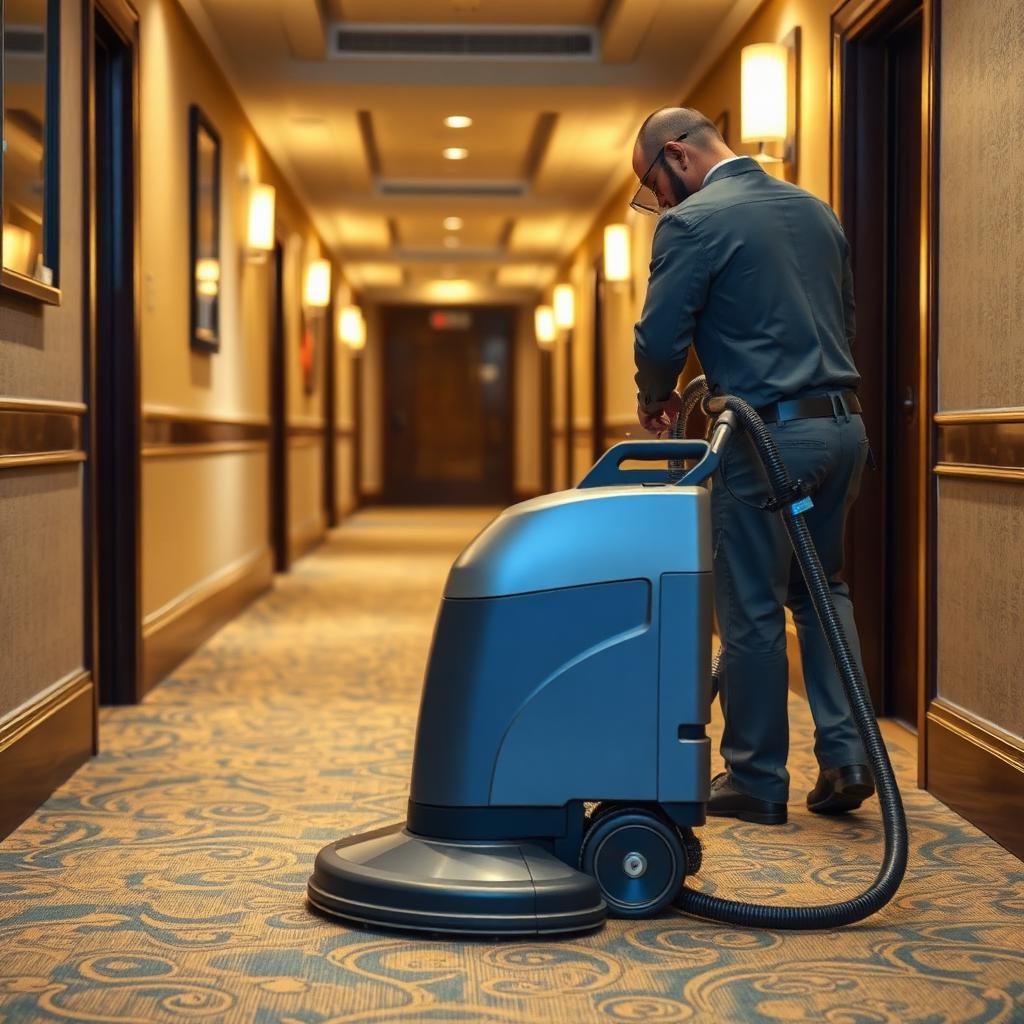
A hotel GM stands in a 4th-floor corridor at 8 a.m. and asks housekeeping why the hall smells like "old vacuum bag" again — three days after a full extraction. Housekeeping did nothing wrong. The extraction pulled everything off the surface, exactly as designed. The smell came back because the source was never on the surface.
Commercial carpet doesn't smell because of what's on top of it. It smells because of what's soaked into the pad and locked into the fiber base. Everything you spray, sprinkle, or extract on the surface treats the wrong layer.
The three layers of a carpet odor Every carpet stack has three distinct zones that hold odor differently:
- The fiber tips — where spills first land. Surface deodorizers and vacuum-and-shampoo work here. Odors clear in minutes but return the moment humidity rises.
- The fiber base and backing — where oils, protein, and organic matter get pressed in by foot traffic. Hot-water extraction reaches this layer. This is where most cleaning stops.
- The pad and subfloor — where urine, spilled drinks, and moisture wick down through the backing. Nothing you apply from above touches this layer, and this is where 80% of recurring odor lives.
If a carpet still smells 48 hours after professional extraction, the source is in the pad — not the fiber.
Deodorizing sprays vs enzymatic treatment A deodorizing spray is a fragrance suspended in a solvent. It evaporates in 4–12 hours and takes its cover-up with it. Fine for a walk-through before a tour; useless for a source problem.
An enzymatic treatment is a live culture of bacteria that digests the organic compound producing the odor — uric acid crystals from pet or human urine, protein from spilled milk or vomit, fatty acids from food. The enzymes eat the source molecule and there's nothing left to smell. The tradeoff: enzymes need moisture, dwell time (6–24 hours), and a delivery method that reaches the pad, not just the fiber.
Most retail "enzyme" sprays fail because they never penetrate below the backing.
The extraction-only mistake Hot-water extraction is essential — it removes the top two layers of soil, and skipping it means the enzyme has to work through a layer of dirt before reaching the source. But **extraction alone will make a bad odor worse in the short term**. It re-wets everything down to the pad, wicks pad odor back up through the fibers as it dries, and produces the classic "clean but smells musty two days later" complaint.
The correct sequence is: extract → apply enzymatic treatment to the affected area → let dwell overnight → light re-extraction the next day → air movers until fully dry.
A 5-step protocol for commercial carpet odor 1. **Find the source, not the stain.** Turn off lights and use a UV/blacklight — pet urine and protein spills fluoresce. Map the actual affected area (usually 2–3× larger than the visible stain) before treating. 2. **Extract the surface soil.** Hot-water extraction with a low-residue detergent. Don't skip this — enzymes need clean access to reach the source. 3. **Sub-surface enzyme injection.** For pad-level contamination, inject enzymatic treatment through the carpet backing with a spotter tool, not a spray bottle. This is the step DIY guides skip and the one that actually ends the odor. 4. **Dwell overnight with air movement.** Enzymes need moisture and time. Air movers keep the treatment from evaporating before it works. 5. **Neutralize residual VOCs.** Once the biological source is gone, a targeted deodorizer (chlorine dioxide or hydroxyl technology, not a fragrance spray) neutralizes any remaining aromatic compounds without adding a competing scent.
When to replace the pad Some contamination is unrecoverable. **Any spill that penetrates to the subfloor and stays wet for more than 48 hours produces microbial growth that no enzyme can reach.** Signs it's time to pull the pad: odor returns within a week of every treatment, visible discoloration on the pad when you lift a corner, a musty note distinct from the original spill smell.
Pulling and replacing a section of pad is disruptive but final. Repeated enzyme treatments on a compromised pad is a $200/month solution to a $600 one-time problem.
The takeaway Surface deodorizers buy hours. Extraction handles the fiber but re-mobilizes the pad. Enzymatic treatment delivered *below* the backing is the only step that treats the actual source — and it only works when the previous two steps set it up correctly.
For hotels, offices, and multi-tenant properties, a scheduled program that combines quarterly extraction, targeted enzyme treatment on flagged areas, and ambient odor control in high-traffic corridors is what keeps carpets smelling neutral month over month, not just the day after cleaning.