
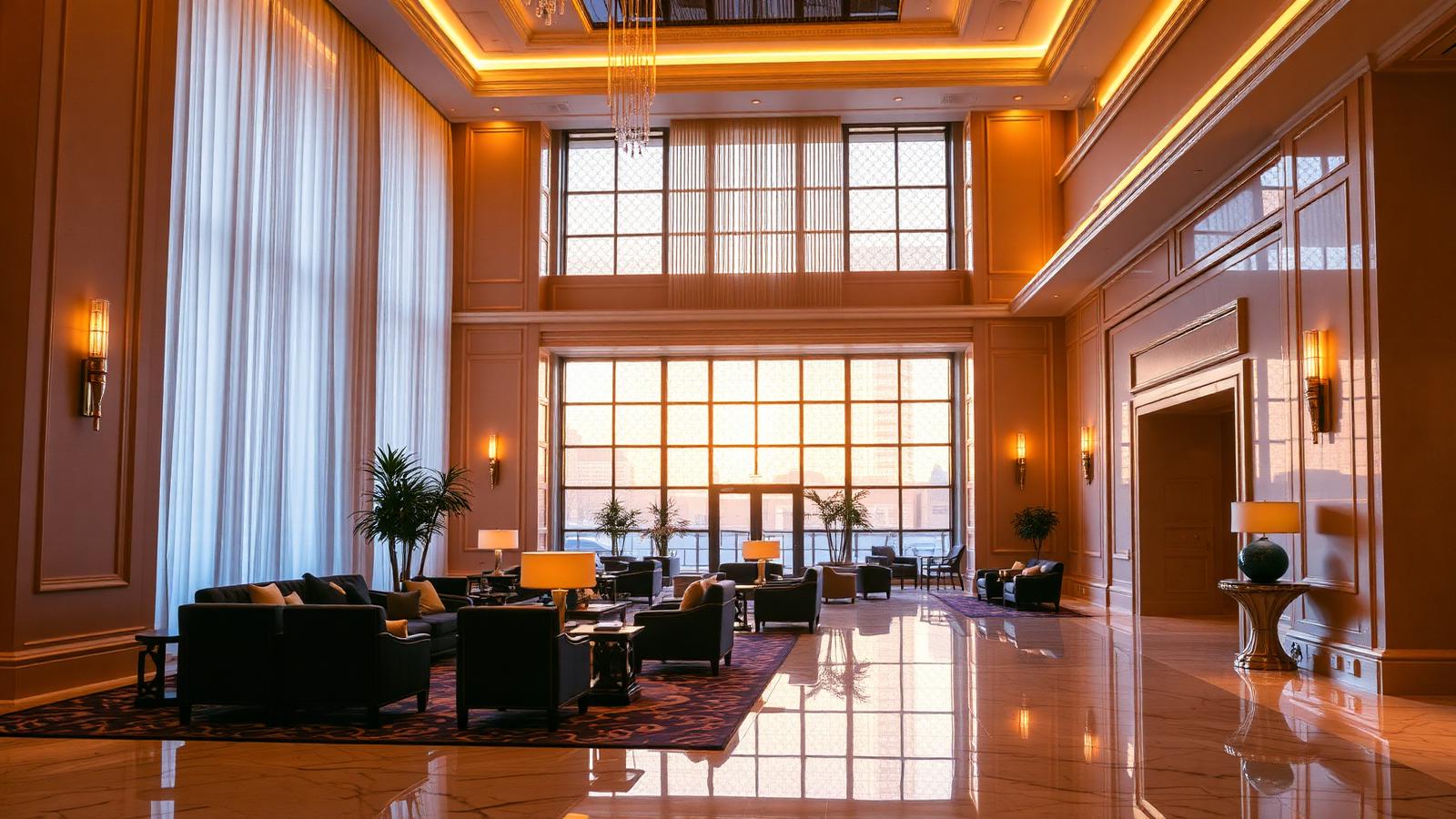
Picture this: a prospective buyer steps out of a black car on Park Avenue, walks through a set of glass doors, and takes their first breath inside your building. In the next six seconds they'll form an impression that no amount of marble, brass, or concierge scripting can fully rewrite. Something in the air is either quietly signaling "this is a place that gets it right" — or nothing is signaling anything at all.
Should the lobby have a scent, and if so, how strong? Is a candle-store diffuser the same as a scenting system? And how do you keep the impression consistent when the same guest steps off the elevator on the 42nd floor?
At Luften, we design and service ambient scent programs for luxury residential towers, hotels, and Class A office lobbies across the tri-state. It can be tricky to know whether to invest in a full property-wide identity or start with the lobby alone, but there is a right answer for your building's positioning.
To help you think about scent as a brand asset instead of an amenity, we'll cover why scent memory works the way it does, the difference between fragrance masking and calibrated ambient scenting, how commercial-grade diffusion differs from retail products, and how to extend the lobby impression to every floor with a system like LUF-Air Freshener. By the end, you'll know what to ask any scenting vendor before signing a contract.
Scent Memory vs. Visual Design Human olfactory processing routes directly through the limbic system — the part of the brain that handles emotion and memory — before the conscious mind interprets what it's smelling. That is why a scent can return you to a specific place decades later, and why a well-scented lobby feels like the building itself rather than a decoration.
Visual design tells guests what a building costs. Scent tells them what a building is. A calibrated scent profile makes a lobby feel intentional in a way finishes alone cannot, and that impression is the hardest thing for a competing property to copy.
Masking vs. Calibrated Ambient Scenting Retail "air fresheners" work by pushing a strong fragrance load into the air, hoping it overpowers anything underneath. In a lobby, the result reads immediately as commercial — the same category of experience as a hotel breakfast buffet or a candle store. Guests notice the product, not the place.
Calibrated ambient scenting operates at fractional concentration. The goal is that a guest never consciously thinks "this lobby smells like X," but instead thinks "this lobby feels good." Calibration is a function of ceiling height, foot traffic, HVAC turnover rate, and seasonal humidity, and it changes over the course of a year. If you can identify the scent within two seconds of walking in, the concentration is wrong.
Retail Diffusers vs. Commercial Delivery Reed diffusers, plug-in fresheners, and consumer-grade cold-air units share one problem: they work at the scale of a room, not a lobby. The result is a hotspot near the device and dead air fifteen feet away, so guests experience the scent in patches instead of as a room.
Commercial delivery uses hidden wall outlets, planter-integrated diffusers, flush ceiling installations, or direct HVAC injection. Each delivery point is sized and placed for the actual airflow of the room. A properly scented lobby has no visible source and no gradient — the guest walks into a coherent space, not a device.
The Lobby vs. Every Floor: Where Buildings Undo Themselves The most common failure in luxury scent programs is stopping at the lobby. A guest gets the impression at the elevator lobby, then rides fourteen floors and steps out into a residential corridor that smells like nothing — or like the apartment that just opened its door. The brand impression collapses.
LUF-Air Freshener extends the same brand-grade scent to every residential floor. The device's cover itself is the fragrance source, paired with a programmable fan that maintains consistent freshness for thirty days. There's no aerosol mist and no synthetic top-note; residents experience the scent the way they would in a well-kept hotel corridor. At the thirty-day mark, the device signals when it's time to replace the cover and battery together — one swap, no separate inventory — and the replaced components return through Luften's closed-loop recycling program. The lobby scent is only worth what it costs if it doesn't stop at the elevator.
Choosing the Right Scent Program for Your Property Start with positioning. A wellness-branded tower and a heritage luxury rental should not share a scent library. A large fragrance library lets property management match the scent to the building — citrus and green tea for wellness, leather and oud for classic luxury, clean cotton for senior living, tea and fig for a hospitality-forward flag.
Then decide on scope. Lobby only is a good starting point and a useful test of the vendor's calibration work. Every-floor extension is what turns a good lobby into a coherent property. HVAC integration is the top of the ladder — invisible, uniform, and centrally controlled.
The right program is unobtrusive, consistent, replaceable in minutes by your porter staff, and something guests remember without being able to say why.
Have a question about lobby scenting or a walk-through of what a full-property program would look like in your building? Our team is here to help — we'll connect you with a scent specialist who works in properties at your level.